Ship more, without hiring for it
A team of specialised agents takes a one-line request to a reviewed pull request — PRD, tech plan, implementation, review and deploy — while your engineers work on what only they can do.
Guardi turns the coding agents you already use into a team that plans, builds, reviews and ships through your workflow — and stops for you at every gate that matters. Quality gates, budgets and security scans included.
Works withClaude Code·Codex·OpenCode·Gemini CLI·Kimi·Zcode
Runs the agents you already use
Works the backlog you already have
Reaches you where you already are
Why Guardi
A single agent in a terminal can write a function. Shipping features takes a plan, a review, a budget, and someone accountable for what merges. Guardi gives your agents that structure — so you get the output of a team without losing the judgement of one.
A team of specialised agents takes a one-line request to a reviewed pull request — PRD, tech plan, implementation, review and deploy — while your engineers work on what only they can do.
Agents stop at the stages you mark. You approve, send back with a note, or abort — from the web or your phone — and every decision is recorded with who made it and why.
Quality gates check tests, the spec and mutation score before a stage can pass. The quality report names what broke a limit — and which agents and models write the code that lasts.
Cost per run, per stage and per model, against a budget you set. When a run goes over, Guardi says by how much, which stage crossed the line, and why.
How it works
A workflow is your SDLC written down once: which agent does each stage, and where a person has to say yes. Run it as many times as you like.
01
Type a sentence, or pick an issue from GitHub or GitLab. Guardi suggests the workflow that fits and attaches the issue as context.
02
Each stage runs on the agent best suited to it, inside an isolated session on your fleet, with project memory carried from stage to stage.
03
Gated stages wait in your Inbox with the brief, the diff, the findings and the cost. One tap approves; a note sends it back.
04
The branch is pushed and a pull request opened. Status, progress comments and the PR link are written back to the issue it came from.
Add idempotency keys to payment retries
payments-api · Feature delivery · run #214
Runs on
technical-product
Produces
PRD.md — goals, requirements R1–R6, acceptance criteria
Then it waits for you
Approval gate · you sign off on scope
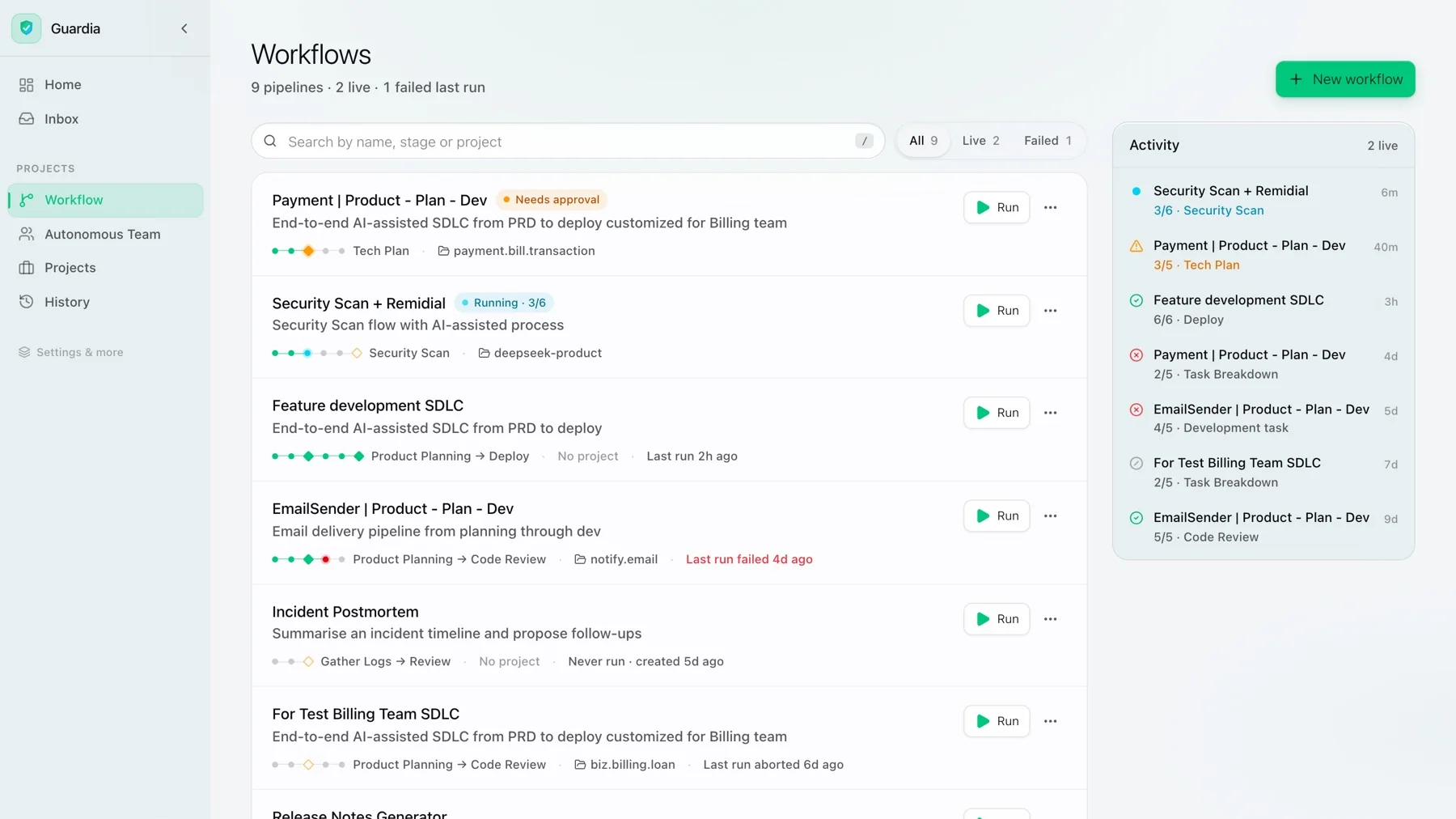
A typical feature pipeline. Click any stage — dots are agent stages, diamonds wait for a person.
Inside the product
Not a wall of tiles. Each page leads with a sentence — where the run stopped, what is over budget, which measure broke a limit — and keeps the detail one click below.
Each workflow draws its pipeline — dots for agent stages, diamonds for gates — and pulses at the stage a run is on. Live work leads: the approval waiting on you, then what is running.
Human at the gate
A gated stage waits in your Inbox with the brief, the findings, the diff and the cost. The buttons say what will happen — and every decision is kept with who made it and their note.
Approve
The next stage starts on its own. No re-triggering, no context to paste again.
Send back
The stage runs again with your note in the agent's prompt.
Abort
The run stops. It isn't a dead end: retry later from the same stage, with your reason carried in.
Add idempotency keys to payment retries
payments-api · Feature delivery · Atlas
THE BRIEF · WHAT YOU ARE APPROVING
Try it — write a note, then approve, send back or abort.
Guardrails
Two things go wrong when agents run unattended: the code quietly gets worse, and the bill quietly gets bigger. Guardi checks both on every run — and tells you in a sentence when something crossed a line.
A stage passes only when its tests pass, the plan's requirements hold, and the tests catch mutants in the changed code. The agent gets an automatic fix; if that makes no progress, the gate asks you.
Tests
1 test fails · TestRetry_ExpiredKeyIsRejected
Spec adherence
R2 contradicted · loop allows 4 attempts, not 3
Mutation score
Mutation score 53% · min 60%
Set a budget per workflow and watch a live estimate against it. Go over, and the breakdown says by how much, which stage crossed the line, and why.
Retries, not the work. 3 retries on Development task burned $0.74 — 46% of the run. Without them the run would have finished inside its budget.
Guardi names one of five causes:
Issues
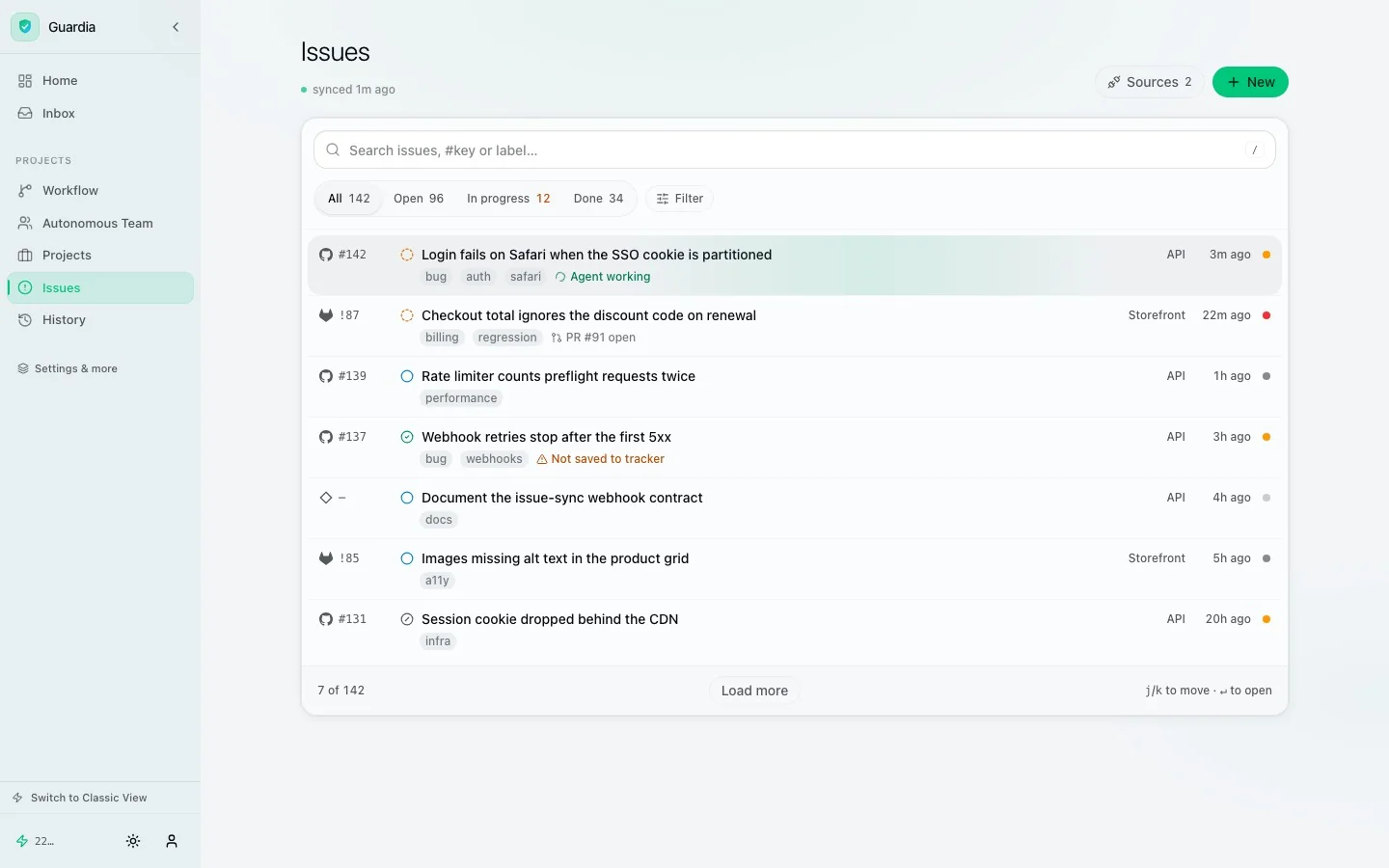
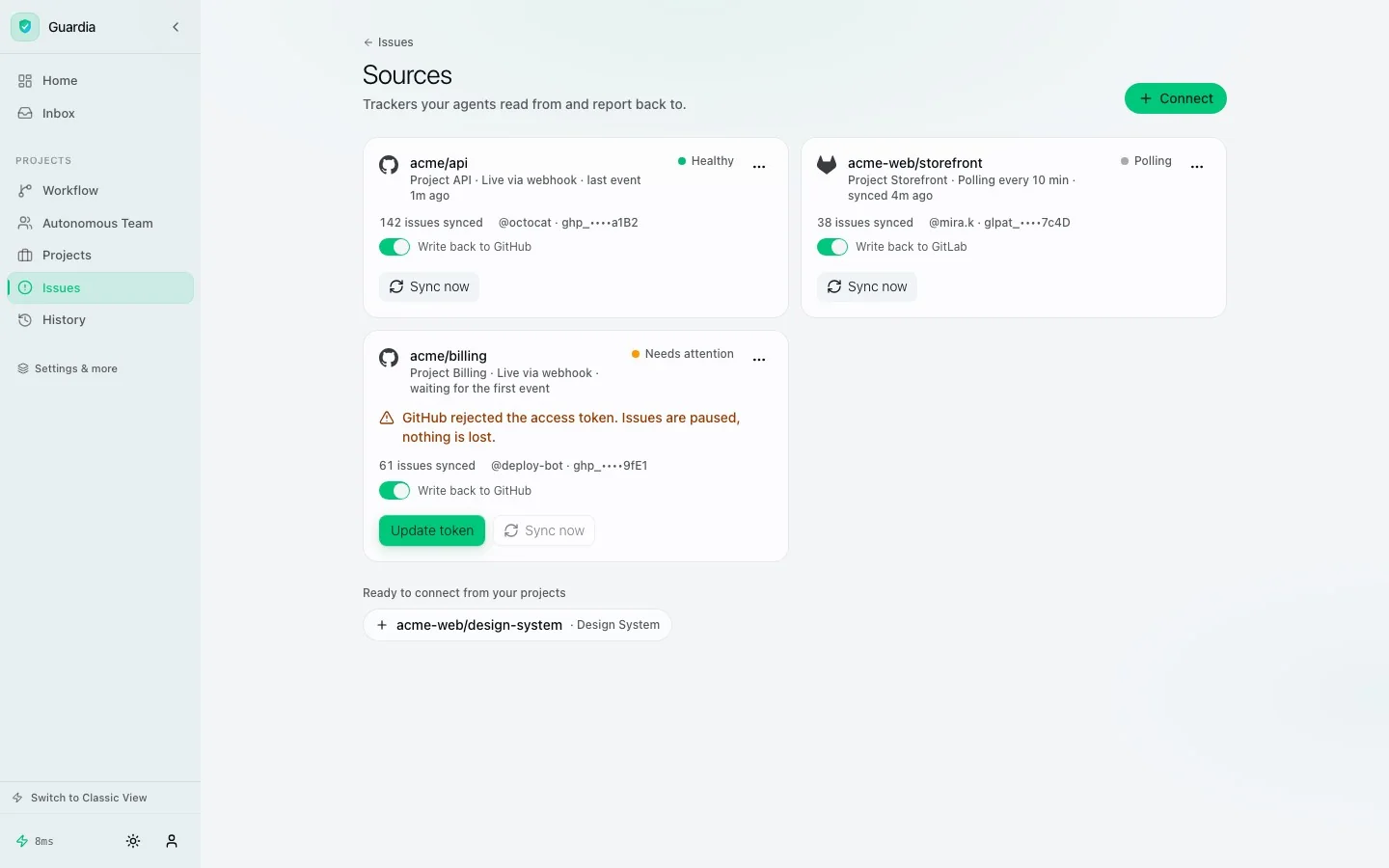
No more copying a title into a prompt and pasting a link back. Connect a tracker once; any issue can be handed to an agent in a sentence, and everything the agent does is written back to where the issue came from.
GitHub or GitLab, cloud or your own instance. Least-privilege token, encrypted, never shown again.
Mirrored next to the ones written in Guardi, labels in colour, provenance on every row.
The likely workflow is suggested from the labels; the issue fills the run's inputs.
Status changes, the agent's progress comments and the PR link land on the original issue.
Security scans
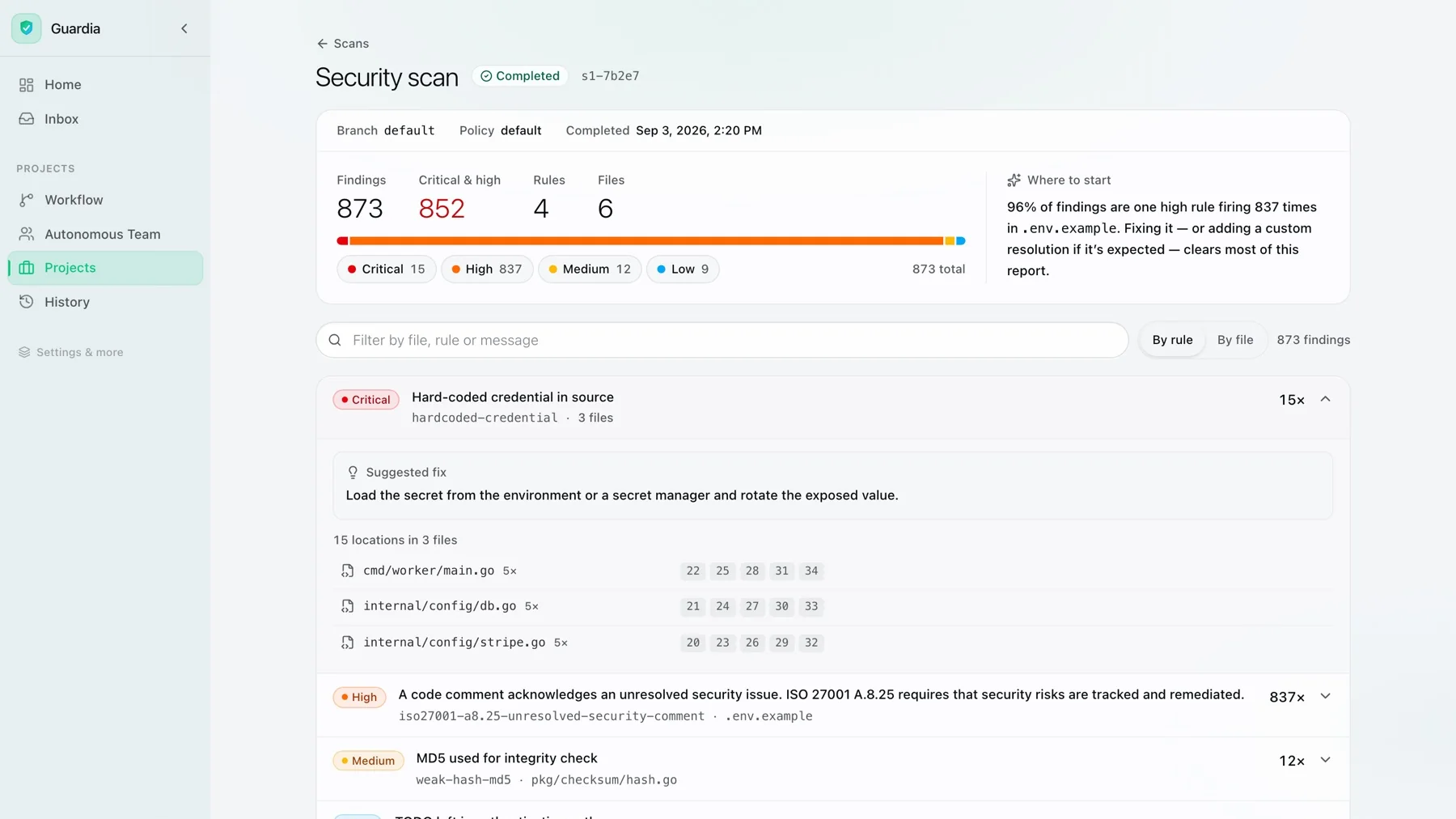
Scans run as a stage in any workflow or on their own. The result opens on what changed and what is causing it — and a click turns findings into tracked issues an agent can fix.
Grouped, not repeated
One rule firing 837 times is one group with one fix — and the files and lines beneath it.
What changed since last time
Each scan compares with the previous one, so a new critical never hides in the total.
Findings become tracked work
Sync a rule's findings to a GitHub or GitLab issue, kept up to date — then hand it to an agent.
Gate the pipeline on it
Put a scan in any workflow. Findings travel with the approval and with the pull request.
Autonomous team
Describe what you're building and Guardi suggests a team: named co-agents with a role, skills, standing instructions and the CLI agent they run on. Keep them, rename them, or bring your own — then decide how much they can do without asking.
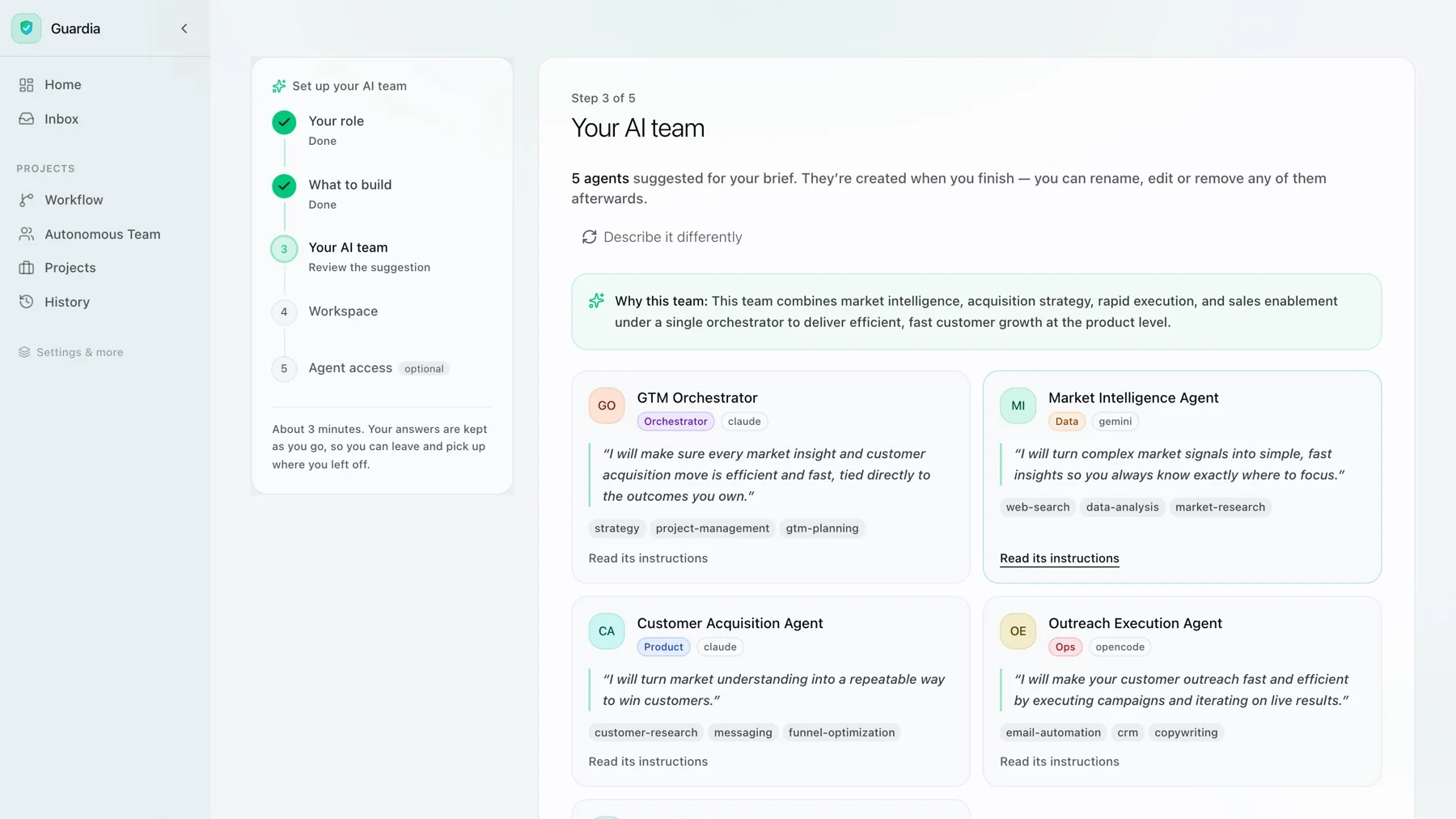
Team autonomy
Low-risk stages advance on their own; planning and shipping still wait for you.
Set per project, and change it as trust builds. Quality gates and budgets apply at every level.
Project memory
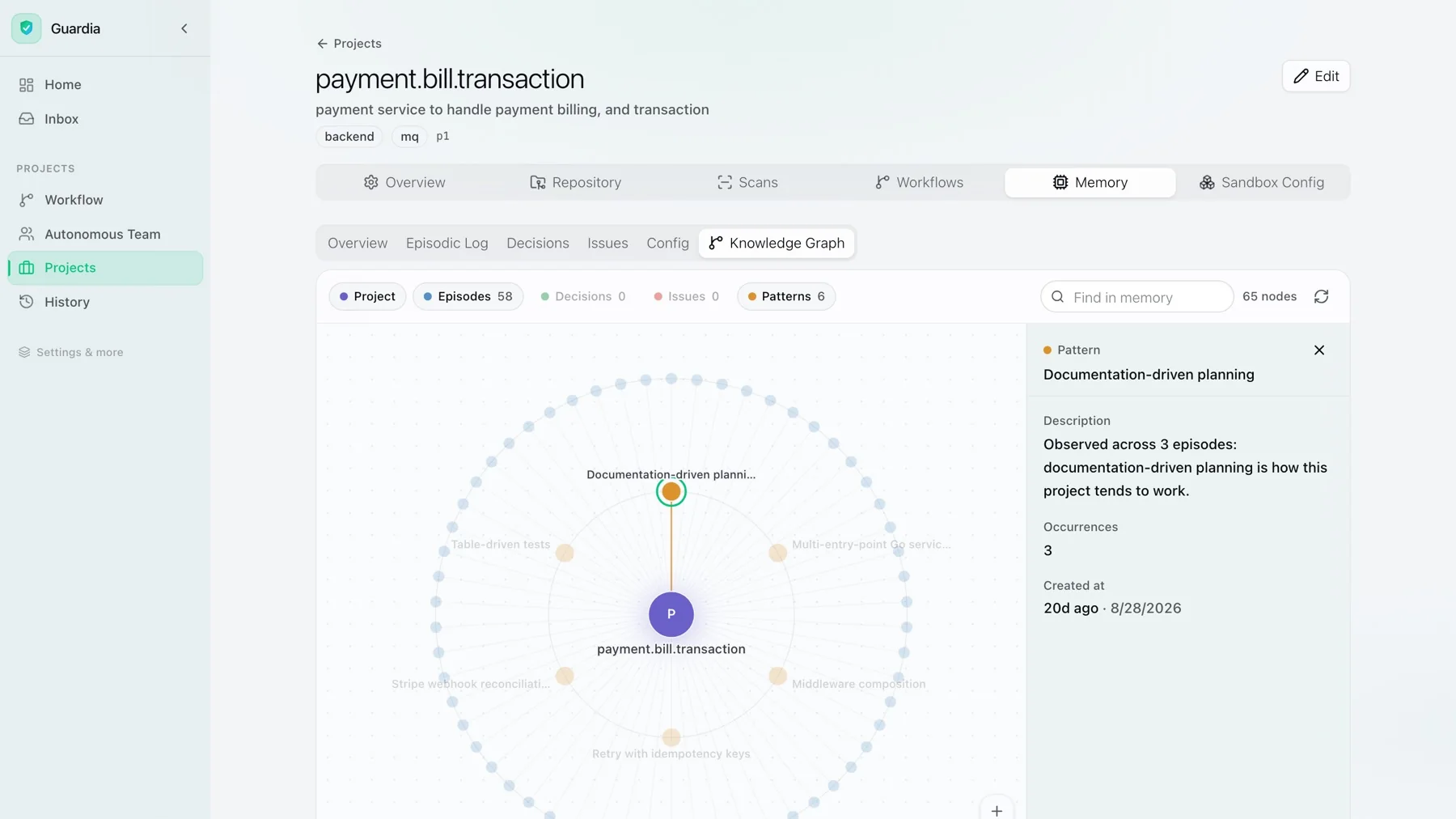
Every stage of a project shares one memory. The tech plan reads the PRD's decisions; the reviewer knows the patterns this codebase follows. Nobody pastes context between stages — and nothing is lost when a chat window closes.
Episodic log
What every agent read, decided and changed — searchable by task.
Decisions
Architecture and product calls, captured where they were made.
Issues
Bugs and follow-ups an agent surfaced mid-task.
Patterns
How this project tends to work, learned across episodes.
Your fleet
Guardi orchestrates; the work happens on nodes you control. Bring your own servers and laptops, or spin up a sandbox for a project — and always know whether anything online can actually run the next job.
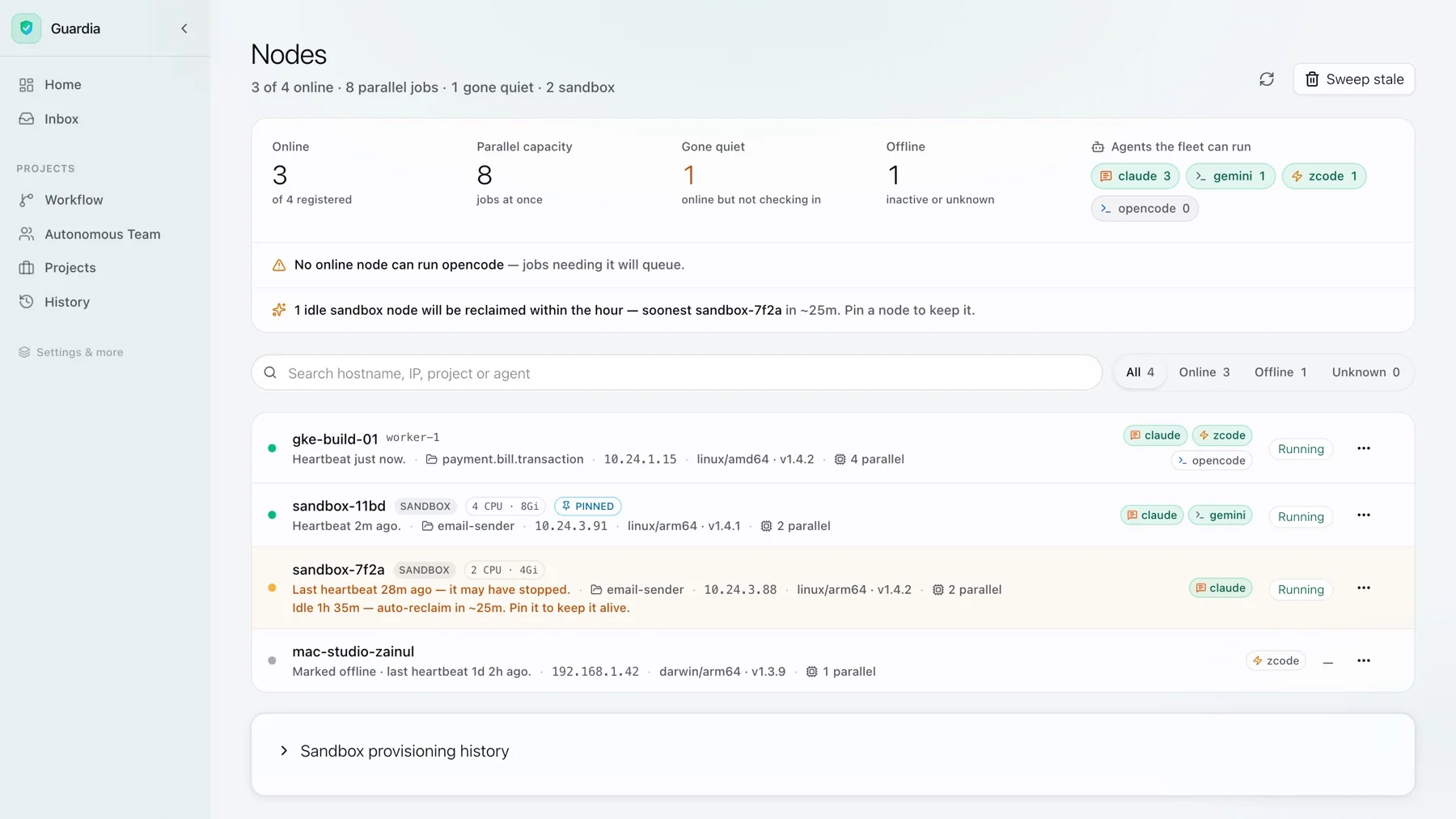
Bring your own machines
Install the worker on any Linux or macOS box. It registers, heartbeats and reports which CLI agents it has.
Or spawn a sandbox
No node for a project? Start an isolated sandbox from the project page, sized to the job, reclaimed when idle.
Health you can trust
Heartbeat age drives status — a machine that has gone quiet reads as quiet, not as active.
Isolated sessions
Each job runs in its own session and workspace, so one job's blast radius never reaches another.
Git Ops built in
Branches named from the run title, commits and pull requests opened for you, protected branches refused.
Capacity at a glance
Parallel job slots, agents installed per node, and a warning before a job is queued with nowhere to run.
Guardi Mobilenow on Android
The decisions that unblock your agents are small — so make them anywhere. See what is running, approve a stage, or send it back with a note, from your phone.
v1.3.0 · APK · 26.7 MB
SHA-256
dea78c9dbbb5049fc39054c4c0b980d1726a2881e5e12ff1bec48c86b8322c68 GuardiZa
Good morning.
2 runs and 1 job in flight.
Live now
Migrate sessions to Redis
Add idempotency keys
A pulse when you open it
What's running, who's waiting, and the one decision that needs you.
Add idempotency keys to payment retries
payments-api · Feature → Review → Ship · Atlas
THE BRIEF · WHAT YOU ARE APPROVING
Face ID confirms · findings travel with the PR
Decide in a tap
The brief, the findings and the cost — approve and ship, or send it back with a note.
Tuesday 24 October
9:41
GUARDInowReview is waiting on you
Add idempotency keys · 2 security findings · $0.84 so far
GUARDI4m agoImplement didn't pass the quality gate
payments-api · mutation score 53%, min 60%
Migrate sessions to Redis12mImplement · Vera$0.42 of $2.00
Told when it matters
A push when a gate needs you; a Live Activity while a run is going.
FAQ
Start with one workflow and one gate. Loosen the reins as the quality report earns your trust.